
Jarman International Core 50 member Swastika Harsh Jajoo will be featured in an upcoming episode of the BS TV Tokyo program “Watashi ga Nihon ni sumu riyu (Why I live in Japan)” scheduled for 9 p.m. on October 31 (Sat). The episode will also be available for anyone to view for free until November 6 on Tver.
“Watashi ga Nihon ni sumu riyu” shares the unique personal stories and careers of internationals living in Japan, as well as the reasons why they chose to make Japan their permanent home.
Swastika was invited to appear on the program due to her work with Futaba Area Tourism Research Association (F-ATRAs), which organizes study tours, events, and other information-sharing activities to help revitalize the Fukushima coastal area devastated by the 2011 earthquake, tsunami, and nuclear disaster. As a manager at F-ATRAs, Swastika helps curate custom-made tours for clients, often with a focus on education, as well as handles communication including translation and interpretation. She is also a poet and is pursuing a PhD in Linguistics at Tohoku University, with research focused on how people talk about furusato (home).
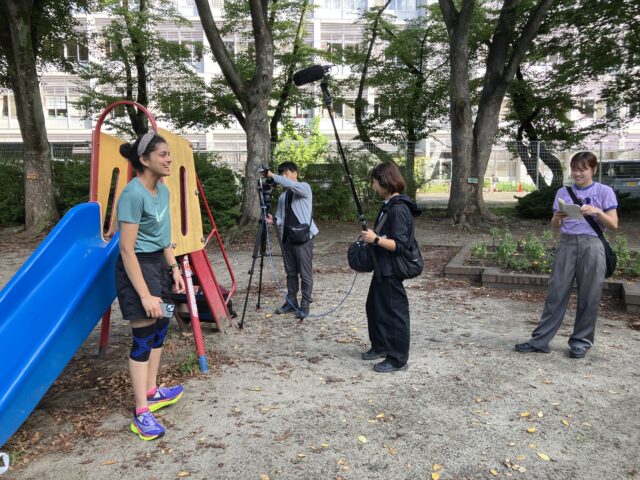
Across a multi-day shoot, the BS TV Tokyo crew filmed Swastika both at work and amid her daily life in the Fukushima towns of Namie and Futaba, as well as in Sendai, where she previously lived and still maintains close friendships. As Swastika recounted to the crew, she knew little about Japan when she first arrived in 2017, but found in the Tohoku region a new home, new perspectives, and treasured communities.
“Having a crew follow my ordinary days, my run, my onigiri order, made me see how much of a life accumulates in small places,” she reflects on the shoot. “I spend my days telling Fukushima’s stories as a guide and researching how people talk about furusato (home). Being filmed turned all of that around: Someone was asking for my story, in the places where it quietly happens. It helped me look at my life more objectively.”
“I hope people come away feeling that home is not only the place you were born. Sometimes it is a riverside you run along, a park where a stranger waves you over, an onigiri that tastes like your mother’s cooking. I found mine in Tohoku, and I’d love for viewers to look at their own hometowns a little differently afterwards,” she adds.
Through the lens of Swastika’s story, the program portrays coastal Fukushima as a place where people go about their daily lives, rather than simply as a disaster site. JI — which helped put the TV crew in touch with Swastika — is proud of her and her colleagues’ contribution to the area’s revitalization, and we look forward to seeing how the warm community there continues to grow going forward.